A Step-by-Step Guide to Cleanroom Validation & Testing
Setting up a cleanroom is only the beginning of contamination control. The true measure of a cleanroom’s performance lies in its validation and testing — proving that the environment consistently meets defined standards under real operating conditions.
Whether it’s a pharmaceutical filling area in Hyderabad, a semiconductor fab in Gujarat, or an EV battery plant in Pune, validation ensures compliance, safety, and reliability. Without it, even the most sophisticated facility is just an expensive shell.
This article walks through a practical, step-by-step guide to cleanroom validation and the essential tests involved, aligned with ISO 14644 and GMP (Good Manufacturing Practice) frameworks.
What is Cleanroom Validation?
Validation is the documented process of proving that a cleanroom performs as designed — in terms of air cleanliness, pressure, temperature, humidity, airflow, and particle control.
It is conducted in three key phases:
- As-Built: Room complete, with all systems installed but no equipment or personnel.
- At-Rest: Equipment installed and running, but no personnel present.
- Operational: Room functioning under normal working conditions with staff.
The objective is to confirm that the cleanroom maintains its ISO class under all three conditions.
The Validation Lifecycle
Validation is not a one-time exercise. It follows a structured lifecycle:
- Design Qualification (DQ)
- Installation Qualification (IQ)
- Operational Qualification (OQ)
- Performance Qualification (PQ)
- Re-Qualification & Periodic Testing
Let’s look at each stage in detail.
- Design Qualification (DQ)
This is the foundation of the validation process. DQ verifies that the cleanroom design meets user requirements and international standards.
Key Activities:
- Review of User Requirement Specification (URS)
- Verification of airflow diagrams, pressure cascades, and zoning
- Compliance check against ISO 14644 and GMP
- Material and personnel flow analysis
Deliverable: Approved Design Qualification Report confirming that the proposed design can achieve the required cleanliness levels.
- Installation Qualification (IQ)
Once construction and system installation are complete, IQ confirms that all components have been installed correctly and according to specifications.
Tests and Verifications:
- Physical inspection of walls, doors, panels, and flooring
- Verification of HEPA/ULPA filter type and installation
- Calibration certificates for sensors, gauges, and instruments
- Ductwork and AHU (Air Handling Unit) inspection
- Power and control system checks
Deliverable: IQ report confirming that all equipment and systems are properly installed and documented.
- Operational Qualification (OQ)
OQ ensures that the cleanroom and its systems operate within design parameters.
This is where testing starts to get technical.
Key Tests Include:
- Airflow Velocity and Uniformity
- Measured using an anemometer.
- Confirms laminar flow speed (e.g., 0.45 m/s ± 20% for ISO 5).
- Air Change Rate (ACH)
- Number of times air is replaced per hour (e.g., 240+ for ISO 5, 60–90 for ISO 7).
- Pressure Differential Testing
- Ensures pressure cascade between zones (typically 10–15 Pa).
- Temperature and Humidity Control
- Monitored for stability and comfort (commonly 20–22°C and 45–55% RH).
- HEPA Filter Integrity (PAO Test or DOP Test)
- Uses aerosol challenge to detect leaks in filters or seals.
- Mandatory for all ISO 5–8 cleanrooms.
Deliverable: Operational Qualification Report validating that system performance aligns with design intent.
- Performance Qualification (PQ)
PQ demonstrates that the cleanroom performs effectively during normal operations — with equipment running and personnel present.
This is the final and most critical validation phase.
Key Tests Include:
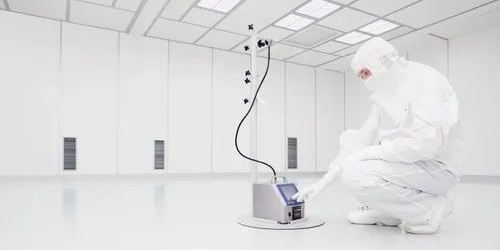
- Particle Count Testing (ISO 14644-1)
- Conducted using a laser particle counter.
- Determines actual cleanliness class by measuring airborne particles (≥0.5 µm).
- Airflow Visualization Test (Smoke Test)
- Visual inspection using non-toxic smoke to confirm airflow direction, uniformity, and absence of dead zones.
- Recovery Test
- Measures how quickly the cleanroom returns to its clean state after particle contamination (target: 15–20 minutes for ISO 7).
- Microbial Monitoring (for GMP areas)
- Settle plates, air samplers, and swabs to measure viable microorganisms.
- Noise and Lighting Tests
- Ensures ergonomic and safe working conditions (noise <65 dB, lighting >300 lux).
Deliverable: Performance Qualification Report certifying that the cleanroom meets its specified ISO class and operational standards.
- Routine Re-Validation and Monitoring
Cleanrooms must be periodically revalidated — typically every 6 to 12 months — to ensure ongoing compliance.
Changes such as filter replacement, HVAC maintenance, or process modification can impact performance.
Recommended Schedule:
| Parameter | Frequency |
| Particle Count | Every 6 months |
| Filter Integrity | Annually or post-maintenance |
| Air Velocity & Pressure | Quarterly |
| Temperature & Humidity | Continuous monitoring |
| Microbial Testing | As per SOP (daily/weekly) |
Real-time data logging and alarm systems are increasingly used in modern facilities to detect deviations early and reduce manual intervention.
Cleanroom Testing Instruments
Validation requires specialized calibrated instruments:
- Laser Particle Counter (ISO 14644 testing)
- Photometer & Aerosol Generator (PAO/HEPA test)
- Anemometer & Manometer (airflow and pressure)
- Thermo-hygrometer (temperature and RH)
- Smoke Generator (airflow visualization)
Engaging a NABL-accredited testing agency ensures data traceability and regulatory acceptance.
Common Validation Mistakes to Avoid
- Testing only once: Validation is not a one-time certification — it’s a continuous commitment.
- Ignoring “as-built” testing: Many issues can be fixed early before the facility is fully operational.
- Neglecting documentation: Every test, observation, and calibration must be recorded and approved.
- Inadequate personnel training: Even perfect systems fail if operators don’t follow protocols.
- Skipping revalidation after changes: Any alteration in HVAC or layout demands re-assessment.
Regulatory References
Cleanroom validation standards are globally harmonized, but implementation differs slightly by industry:
- ISO 14644-1 & 14644-2 – Air cleanliness classification and testing methods
- EU-GMP Annex 1 – Sterile product manufacturing (pharma)
- WHO GMP Guidelines – Global benchmark for developing nations
- US Federal Standard 209E – Legacy reference (still widely cited)
In India, Schedule M (Drugs & Cosmetics Act) and ISO 14644 together define the framework for most regulated environments.
India’s Growing Validation Ecosystem
India now has a strong ecosystem of validation service providers, NABL-accredited labs, and indigenous equipment manufacturers.
From Bengaluru’s biotech clusters to Noida’s electronics corridors, cleanroom validation is becoming a specialized discipline — supported by data-driven testing, real-time monitoring, and predictive maintenance.
Many modern facilities now integrate IoT-based sensors that continuously track differential pressure, temperature, and particle count — transforming cleanroom validation from a periodic activity into a live, continuous assurance process.
Conclusion
Cleanroom validation and testing form the heartbeat of contamination control.
A well-built cleanroom without validation is like a laboratory without instruments — impressive but unproven.
Each stage — DQ, IQ, OQ, PQ — builds confidence that the environment performs as intended, protects the product, and complies with global standards.
Regular testing, coupled with trained staff and disciplined maintenance, ensures that your cleanroom remains not just clean, but consistently compliant.