
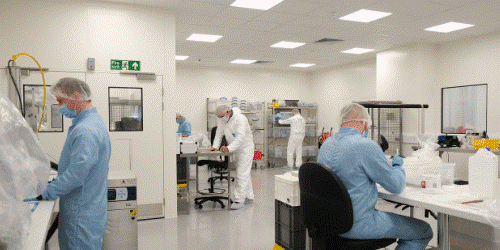
What is a Cleanroom? Understanding ISO Classifications and Applications
In a world driven by precision — whether it’s manufacturing microchips, filling vaccines, or assembling EV batteries — even a single microscopic particle can cause product failure or contamination. This is where cleanrooms come in. They are not just “rooms with filtered air” but engineered environments designed to control particulate and microbial contamination to extremely low levels.
India’s fast-growing sectors — pharmaceuticals, semiconductors, healthcare R&D, aerospace, and electric vehicles — are increasingly adopting cleanroom technology to meet global standards such as ISO 14644 and Good Manufacturing Practice (GMP). Understanding how cleanrooms are classified and applied is the foundation for any organization entering high-precision manufacturing.
What Is a Cleanroom?
A cleanroom is a controlled environment in which airborne particles, temperature, humidity, pressure, and airflow are maintained within strict limits. The goal is to minimize contamination that could affect products, experiments, or processes.
A cleanroom achieves this control through a combination of:
- HEPA or ULPA filters that remove 99.97–99.999% of airborne particles.
- Air Handling Units (AHUs) that provide a high number of air changes per hour.
- Laminar or turbulent airflow patterns to direct clean air across critical areas.
- Positive or negative pressure gradients to prevent cross-contamination.
- Cleanroom-compatible surfaces and furnishings that do not shed dust.
- Disciplined personnel behavior, including specialized gowning and movement procedures.
The ultimate measure of a cleanroom is air cleanliness by particle concentration — which is defined by ISO 14644-1. Understanding ISO 14644-1 Classifications
The international standard ISO 14644-1 classifies cleanrooms into nine categories, from ISO Class 1 (ultra-clean) to ISO Class 9 (least stringent). The classification is based on the maximum number of allowable airborne particles per cubic meter at various particle sizes.
| ISO Class | Maximum Particles ≥0.5 μm/m³ | Typical Application |
| ISO 1 | 10 | Nanotechnology, advanced optics |
| ISO 3 | 1,000 | Semiconductor wafer fabrication |
| ISO 5 | 100,000 | Aseptic pharmaceutical filling, precision electronics |
| ISO 7 | 352,000,000 | EV battery assembly, aerospace components |
| ISO 8 | 3,520,000,000 | General laboratories, packaging areas |
In practice, most Indian industries operate between ISO 5 and ISO 8, depending on process sensitivity and cost considerations.
How ISO Classification Is Determined
Cleanroom classification is verified through particle count testing using calibrated laser particle counters. The testing is performed at rest (“as-built”) and during operation (“in use”) to simulate real conditions.
Key parameters measured include:
- Particle concentration at different micron sizes (e.g., 0.3 µm, 0.5 µm, 1 µm).
- Air change rate (ACH) – how many times per hour the air in the room is replaced.
- Pressure differential between adjacent zones (e.g., +15 Pa between ISO 7 and ISO 8).
- Temperature and relative humidity, as they influence particle behavior.
The lower the ISO class, the higher the airflow rate, filtration requirement, and energy consumption. Hence, cleanroom classification is always a balance between process need and cost efficiency.
Cleanroom Design Zones
Cleanrooms are rarely built to a single class throughout. Instead, they are zoned:
- Critical Zone – where the product is exposed (e.g., ISO 5).
- Background Zone – surrounding support area (e.g., ISO 7).
- Gowning/Material Airlocks – controlled entry and exit points (e.g., ISO 8).
This cascade of cleanliness ensures that contamination is contained and directed away from sensitive areas.
Cleanroom Applications Across Industries
- Pharmaceuticals and Biotechnology
Cleanrooms are essential in drug formulation, sterile filling, and vaccine manufacturing. Regulatory frameworks like WHO-GMP, EU-GMP, and Schedule M require maintaining specific ISO levels:
- Grade A (≈ ISO 5): Aseptic filling and compounding.
- Grade B/C (≈ ISO 6–7): Background and preparation zones.
- Grade D (≈ ISO 8): General processing areas.
Here, microbial monitoring, cleaning validation, and operator discipline are as crucial as particle counts.
- Semiconductors and Electronics
A 0.1-micron particle can destroy a transistor or sensor. Semiconductor fabs therefore operate at ISO 3–5 levels with full laminar airflow, anti-vibration floors, and electrostatic discharge (ESD) control. As India establishes its first semiconductor foundries under the India Semiconductor Mission, world-class cleanroom infrastructure will be the defining element.
- Electric Vehicle (EV) Battery Manufacturing
Cleanrooms in EV cell manufacturing prevent moisture and dust contamination during electrode coating and assembly. Even trace humidity can trigger lithium reactions. Dry rooms with relative humidity below 1% and ISO 7–8 cleanliness are now standard for advanced cell production.
- Healthcare, Diagnostics, and R&D Labs
Hospital operating theatres, IVF labs, and BSL-2/BSL-3 containment labs rely on cleanroom principles to protect both patient and researcher. Pressure zoning (positive for surgery, negative for pathogens) and HEPA-filtered exhaust systems are key features.
- Aerospace and Defense
Cleanrooms support the assembly of satellites, avionics, and defense optics. These areas often combine ISO 6–7 cleanliness with vibration isolation and humidity control to ensure precision alignment and calibration.
Key Components of a Cleanroom
- HVAC System – Controls air quality, temperature, and humidity.
- HEPA/ULPA Filters – Provide primary particle filtration.
- Airlocks and Pass Boxes – Prevent contamination during personnel and material transfer.
- Modular Wall Panels and Flooring – Non-porous, smooth, and easy to sanitize.
- Instrumentation and Sensors – Real-time monitoring of pressure, temperature, and particle count.
Together, these systems ensure compliance and maintain stability over time.
India’s Evolving Cleanroom Landscape
India’s cleanroom industry, once limited to pharmaceuticals, is now diversifying rapidly.
Government initiatives such as Make in India, PLI (Production Linked Incentive) schemes, and the Semiconductor Mission are creating demand for local cleanroom expertise, modular construction technology, and indigenous HVAC manufacturing.
Domestic cleanroom suppliers are now offering turnkey solutions — from concept design and air balancing to ISO validation — reducing dependency on imports and accelerating project timelines.
Best Practices for Implementing a Cleanroom
- Define the process before defining the class. Over-specifying the ISO level drives cost without adding value.
- Plan personnel and material flow to prevent cross-contamination.
- Use compatible finishes and equipment that minimize dust generation.
- Establish Standard Operating Procedures (SOPs) for gowning, cleaning, and monitoring.
- Conduct regular revalidation to sustain performance and regulatory compliance.
Conclusion
A cleanroom is not merely an architectural or HVAC challenge — it is a fusion of design, engineering, and discipline. Understanding ISO classifications helps industries design environments that are not just clean but fit for purpose.
Whether it’s an EV cell plant in Gujarat, a vaccine line in Hyderabad, or a defense optics lab in Bengaluru, cleanroom standards form the invisible infrastructure of precision manufacturing in modern India.